- First Touch
- Posts
- Winter Blues: A Few Natural Strategies for Depression and Anxiety
Winter Blues: A Few Natural Strategies for Depression and Anxiety

Leigh Erin Connealy
February 02, 2026
I wanted to find a way to create a deeper connection with my followers and provide more insights into the content I share on other platforms. I'm excited to give you all a closer, more personal look into my world—sharing insights from my life, my research, and work.
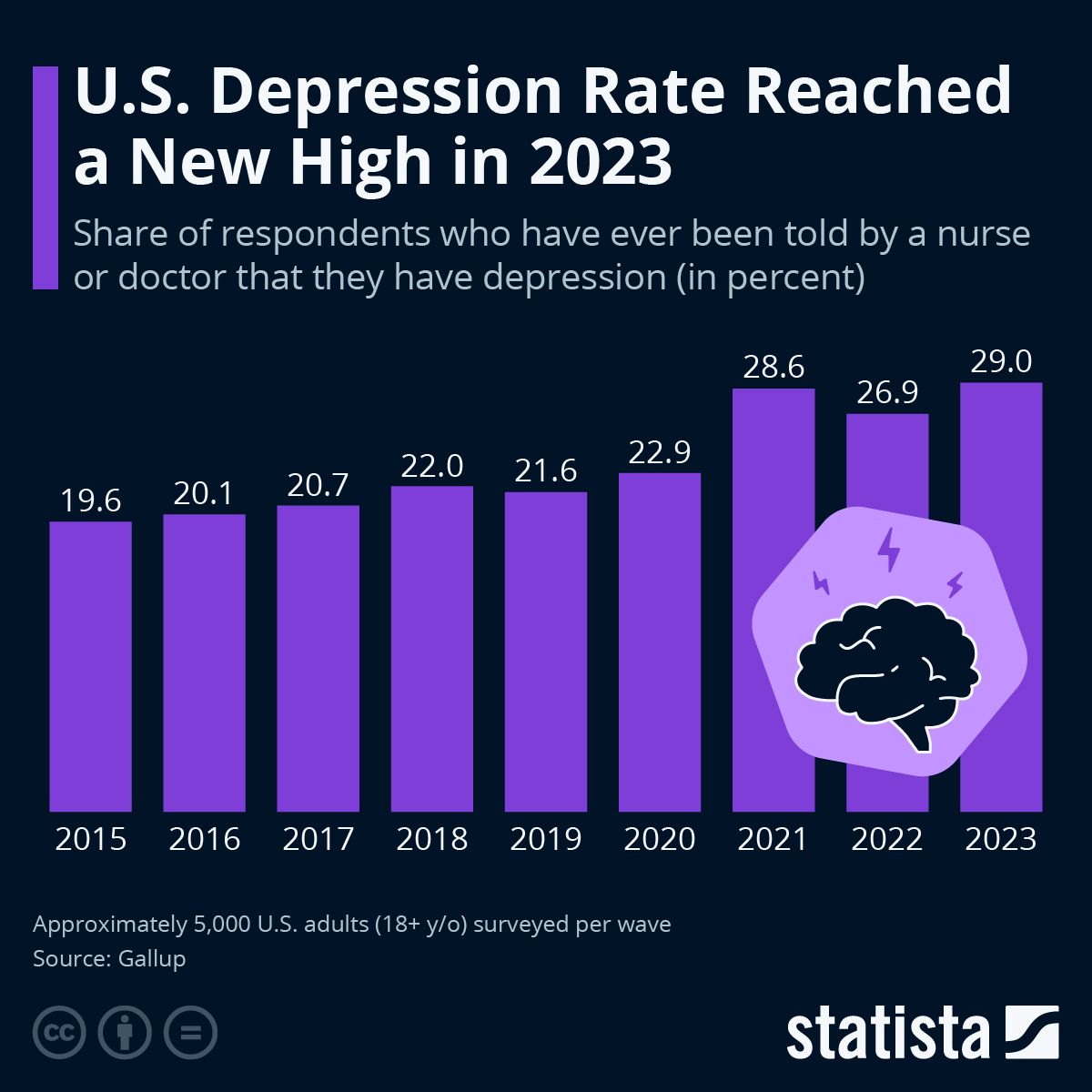
Rates of depression and anxiety are increasing.
Rates of depression have risen sharply over the past two decades, with the largest increases seen in adolescents and young adults. National survey data show that depression in teens and young adults has roughly doubled since the mid-2000s, despite increased awareness and treatment.
The use of antidepressants, especially SSRIs (selective serotonin reuptake inhibitors), has become extremely common. In the United States, roughly 1 in 6 adults reports taking an antidepressant, and usage is even higher among teens and young women.
Why are rates rising?
Mental health is inseparable from physical health. Our metabolism, hormones, nutrient status, etc. all influence our brain function. So, the same factors that are contributing to increasing cancer rates are also driving anxiety and depression:
Toxin overload (xenoestrogens, plastics, pesticides, heavy metals, etc.)
Diets high in seed oils
Sedentary lifestyles
Lack of sunlight
Hormone imbalances
Low thyroid function
Nutrient deficiencies
Disrupted sleep
Blue light exposure
Chronic stress
EMF exposures
Personal stressors (relationships, finances, etc.)
Social isolation
Because of this, healing often requires more than just positive thinking. It means supporting the whole person: metabolically, emotionally, and spiritually.
And while there are chemical and hormonal imbalances associated to depression, I think a lot of aspects of modern life directly contribute to the increasing diagnoses. Our environments do not facilitate meaning, creativity, purpose, or true connection. Over time, our bodies can start to see this as a stressor.
Dr. Ray Peat talked a lot about “learned helplessness” which is a psychological state where a person (or animal) feels powerless to change their situation, even when opportunities for change are available, because repeated past experiences have taught them that their actions don’t make a difference.
In his research, he found that low thyroid function, elevated serotonin, and chronically high stress hormones like cortisol can physiologically reinforce this mental state, by dulling motivation, impairing mitochondrial energy production in the brain, and weakening dopamine signaling (which drives initiative and reward-seeking behavior). The body and mind are in constant dialogue.
Conversely, a 2018 study found that environmental enrichment (ie: enhancing surroundings and experiences) is a beneficial intervention for reducing anxiety, fear, and stress.
There is no magic bullet for depression. I don’t necessarily think depression is something that needs to be suppressed medically. We have to innocently observe the state of our life. Whether it’s environmental stressors, hormone imbalance, nutrition, sunlight, etc., it’s an invitation to look deeper.
To treat depression, we usually need to change our environment.
The brain and nervous system are constantly responding to the conditions we live in—light, noise, stress, social connection, movement, and a sense of safety. When those inputs are chronically negative or overwhelming, the nervous system adapts by conserving energy, dampening motivation, and narrowing focus. Over time, that adaptation can look like depression. A few strategies for treating anxiety and depression:
Spend time in nature. We were designed to live closely with nature. Any separation from the natural world can increase perceived stress on the body, depression, and anxiety.
Write down your thoughts on paper without editing or filtering. Although verbalizing thoughts to someone else can help, we sometimes outsource their ability to make meaning from our own thoughts. Writing forces us to organize what is happening in our mind and self-reflect.
Get sunlight in the morning, at lunch, and sunset.
Significantly limit news or technology. Our brains weren’t designed to handle excessive negative information. It puts a huge amount of pressure on the nervous system. I try to focus my energy on the present moment—the people around me and what I can realistically do each day to bring positive change into the world.
Join a sport. Tennis helps release anger, pickleball keeps you active and social, run clubs are a great way to meet people, boxing teaches you how to fight for yourself.
Develop a non-verbal hobby, something creative to give your mind a break.
Focus on creating. A lot of anxiety is due to inaction. Putting your work out into the world can help move stagnant energy and give purpose.
Read ancient books (physical copies not on phones or tablets). Channeling the wisdom of the past helps us find deeper meaning from timeless ideas, free from modern distractions.
The ego likes the known, even if the known is suffering:
Ask yourself: What is the resistance between you and the thing that you want?
Have faith that there’s something beautiful waiting for you.
This is the hero’s journey.
Our weaknesses give us a chance to be brave.
Speak to yourself with love, just like you would to your mother or friend.
Some physical interventions:
Because the mind is the body, supporting mental health often starts with supporting physical health. Interventions that improve energy production, hormone balance, and nervous system regulation can directly influence mood.
High dose thiamine: A study from the University of Cambridge found that patients with severe depression had hypometabolic regions in the prefrontal cortex—the area responsible for decision-making, emotional regulation, and motivation. This region showed an impaired ability to use glucose, which is essential for brain health. Since thiamine is a key cofactor in glucose metabolism, high doses may help restore metabolic function and restore energy into the brain.
Thyroid hormone (T3): A study in JAMA psychiatry found that many depressed patients also had hypothyroidism. More than two-thirds of mildly depressed patients—and almost all moderately and severely depressed patients—had low T3 levels. TSH was elevated in almost 55% of the patients.
Improve digestion: Gut inflammation can increase serotonin levels (nearly 90 percent of serotonin is made in the gut). This is because one of serotonin’s main roles is to stimulate peristalsis, the movement of food through the digestive tract. When digestion is impaired serotonin production can become excessive, leading to gut motility issues, bloating, and increased stress/excitatory signaling to the brain via the gut-brain axis. Excess serotonin in circulation can contribute to anxiety, fatigue, and mood imbalances.
Magnesium: enhances GABA, calming the nervous system and reducing stress. It balances cortisol, prevents overstimulation, and supports ATP production for brain energy. Rapid recovery from major depression using magnesium treatment, Medical Hypotheses, 2006.
Cyproheptadine: an antihistamine that also acts as a serotonin receptor antagonist, meaning it blocks serotonin receptors. It reduces serotonin's excitatory effects, which contributes to its calming and anti-anxiety properties
Progesterone & pregnenolone: soothing neurosteroids that protect the brain from stress, anxiety, and depression. Both enhance GABA, the brain’s primary calming neurotransmitter, which helps reduce excitability and promote relaxation. They also block the effects of cortisol and block estrogen. Estrogen excess has been linked to suicidal depression, irritability, aggressiveness, and anxiety. One study found that estrogen amplifies the stress response in areas of the brain most closely associated with depression and other stress-related mental illnesses (Shors and Leurner, 2003). Both progesterone and pregnenolone can block these effects.
Red light therapy: "For both seasonal and nonseasonal depression, the effectiveness of light therapy is approximately the same as antidepressant medications, or popular forms of psychotherapy such as cognitive behavioral therapy," says Dr. Richard S. Schwartz, associate professor of psychiatry at Harvard Medical School. Although evidence varies from study to study, each of these different therapies reportedly improves symptoms in between 40% to 60% of people“ (Corliss, 2022).
Aspirin: in a few studies, aspirin has been shown to decrease neuroinflammation and improve stress related to depression and anxiety (Xiang Ng et al., 2019).
Neurotransmitter testing. At the Center, we offer a urine-based neurotransmitter test to identify specific chemical imbalances that may be driving anxiety and depression. This helps determine which amino acids (precursors to neurotransmitters) are needed to help restore balance.
The health of our mind is also the health of our body. ❤️❤️❤️
If you’re interested in individualized support for physical and mental health, please contact the Center! Our focus is on precise, personalized care tailored to each individual.
To learn more or schedule a consultation, please contact us at 949-680-1880. For a full list of services and modalities, see below.
|

The Cancer Revolution is now available ❤️
In the second edition of The Cancer Revolution, I updated every chapter, reviewed new research, added the latest diagnostics and early-detection tools, and included two new chapters on voltage/frequency medicine and the expanding field of immunotherapy. You’ll also find updated nutrition guidance, food plans, and practical lifestyle recommendations.
This edition is a comprehensive guide for anyone who wants to learn more about how I approach cancer care from an integrative perspective—and how these strategies can support healing.
There’s so much you can do to support healing and live a full, cancer-free life. 💪

Talk soon ❤️,
Dr. C